
Proper Perspective
what old books can teach us

Between my husband and me, our house contains a lot of books. Some we bought simply to fulfill grad school assignments or continuing education requirements. Some we bought or were gifted on the enthusiastic recommendation of trusted friends or guides. Still others we picked up at yard sales or our local independent bookstore’s fill-a-bag-for-$10 sidewalk sale.
And then there are some whose origin is mysterious, and I have no earthly idea how they landed on our shelves.
As I looked toward Lent this year, I wanted to engage with a daily meditation to guide my heart and mind and to support the fasting practices to which I had already committed. (*gulp*) Rather than purchasing a new book, I turned to our burgeoning bookshelves and planned to re-engage a particular book I’d used in a few years ago. But as I pulled that book from the stacks, another book with a tattered cover caught my eye.
You’ve probably never heard of either the book (Journey to Easter) or the author (Laurence N. Field), and frankly, neither had I. Probably because it was published in 1957 and the author is of a different theological tradition than my own.
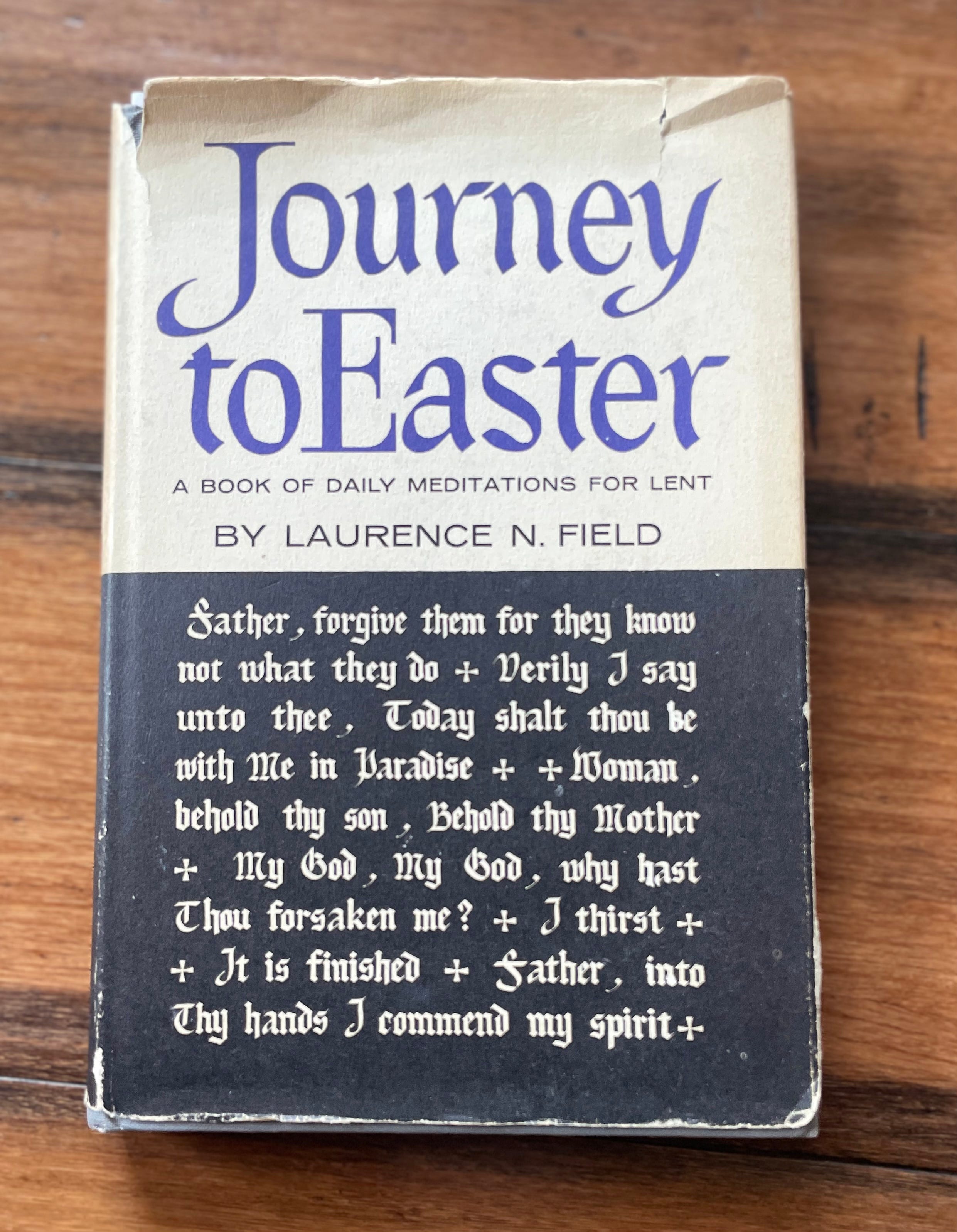
Where it came from, I also have no idea, but in spite of its tattered and rather plain cover, I felt drawn to make it my Lenten reading companion. The cadence of syntax is a bit more formal and the accompanying poems or hymns are unfamiliar, but its contents have already pleasantly surprised me, challenging me and pushing me toward Jesus.
In particular, what I read on Monday has been rattling around in my head; the relevance of the author’s reflections struck me:
“Even now in our so-called enlightened age, after two thousand years of the lengthening shadow of His presence, the world is able only to toddle after Him in its best thinking, trying in vain to catch up with His vision, and seemingly unable to assimilate or act on His simplest precept, on anything like a world-wide scale. . . .
“During Lent it is customary to set aside a certain modicum of time to contemplate Him, particularly the last lap of His journey. ‘Come,’ we say, ‘let us take a little time off to feel sorry for Him now before Easter, as He staggers up Golgotha hill! . . . when the world is burning and groups and nations are busy crucifying Him anew on a scale that the centurion of the cross, and his little corporal’s guard — nor all history, for that matter — never dreamed of! . . . Merciful Savior, do Thou feel sorry for us — this mad planet that after two world wars in one generation, and a taste of atomic destruction besides, has not yet had its belly full but can still find leadership and depravity enough for one more try! This bedeviled world, in which even our own beloved American can return from the holocaust and re-dedicate itself seven times worse than ever to soaring crime waves, greed, cynicism, and lechery!” (pp 18-19).
How can something written almost 70 years ago interpret my troubled heart so accurately?
I don’t know about you, but the constant chaos of the news cycle, the incessant barrage of information paralyzes me some days. I don’t know what to do with it all or how to show up.
I lack the long view. This short-sightedness can lead to a fatalism, a hopelessness that is not from God. It can also lead me to put on filtered glasses, seeing the past through a nostalgic, sepia filter that blurs its sharp edges and obscures its sins and shortcomings.
Without the hindsight gifted to us through the collective voices of Christians through the annals of time, we can miss the truth that
humans have always needed a Savior,
and
the God who saves has always been calling us home.
C.S. Lewis writes that reading old books “puts the controversies of the moment in their proper perspective.”
Friends, we ought to read books with tattered covers more often. I tend to reach for the newest release from my favorite current authors, the ones with witty titles and winsome aesthetics. Though they certainly have wise and insightful perspectives on the spiritual life, the authors generally breathe the same cultural air that I do.
Even when I purposefully vary the gender, and ethnic and global backgrounds of the authors I read, we still swim in the same twenty-first century water.
There’s something to be said for hearing centuries, millennia even, of voices echo through history to shed light on our current existence, to share in our suffering, to remind us that our the-same-yesterday-today-and-forever God will see us through too.
And that same God chooses us to shine Light, to speak Life, to spread Love right where we’re planted.
“You think your pain and your heartbreak are unprecedented in the history of the world, but then you read.” ~ James Baldwin
Oh how we love to say that we’re living in “unprecedented times” as though we’re living a brand-new story, some unique and individualized plot with unpredictable twists and turns, but let us not forget the ancient wisdom of the author of Ecclesiastes who reminds us
“What has been is what will be,
and what has been done is what will be done;
there is nothing new under the sun.” (1:9)
People have suffered under the unjust rule of tyrants and empires.
People have used power to control and oppress and mercilessly kill one another, sometimes even in the name of God.
People have lived pandemics and wars.
People have navigated unstable governmental and financial systems.
None of this is to diminish the forms of evil that possess us today — corruption and greed and self-centeredness and hatred and rage and malice and the list goes on — or the pain and struggle that is life on this beautiful and broken planet.
But it is to put what we’re experiencing and living into proper perspective.
Because when it’s put into proper perspective, I realize I don’t have to fear it or resist it or force it to be what I wish it were. Rather, with God, I can show up to my life as it is and, by doing so, learn what it means to overcome.
Yes, humans — all of us — still carry capacity to do heinous things to one another, we also carry within us the image of God, a haunt of grace, an undercurrent of goodness. That capacity, too, is in our reach, and in the end, that is what overcomes.
“Here on earth you will have many trials and sorrows. But take heart, because I have overcome the world!” (John 16:33, NLT)
The old, tattered texts can help us get our heads out of the sand they’re stuck in, inviting us to look up and to remember that indeed, there is nothing new under the sun — the same God who took on flesh to dwell among us still infiltrates our existence with his Light and Goodness through every small act done in Love.
Until next time,
Kerry
Thank you, Kerry. I needed this reminder today.
Terrific and thought provoking.